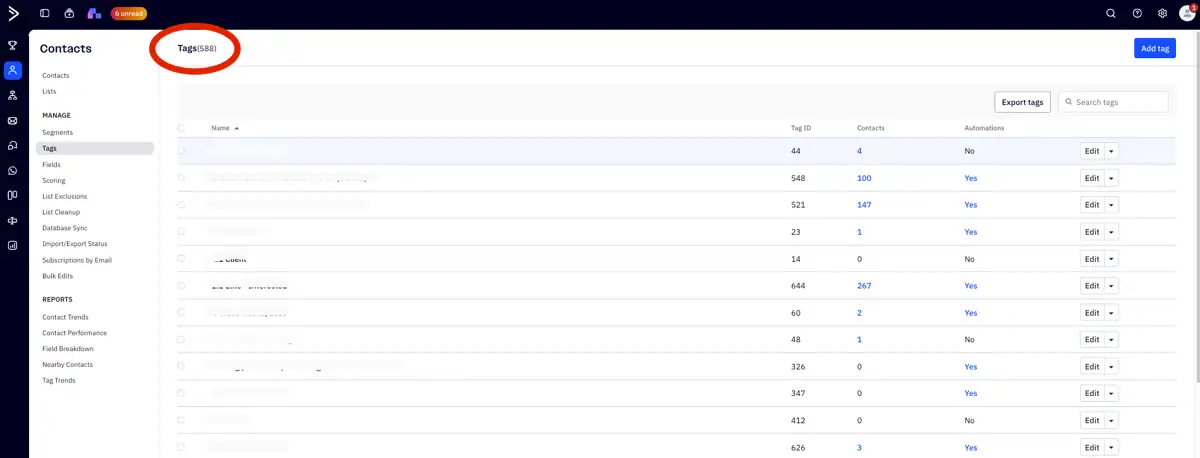
The last account I opened in ActiveCampaign for the first time had 135 active automations and over 700 tags. Some were duplicated 3 or 4 times under slightly different names, and a few nobody in the company could explain, including the person who’d built them.
It’s not the first time I’ve encountered such a mess. Actually, it’s quite the opposite. Even though it’s rare to encounter 700 tags (it was a big account with years of untidiness piled up), it’s not rare to encounter chaos and a complete lack of structure.
On the other hand, many clients have come to me with a list of 10,000 emails and zero messages sent. That’s another problem, but a problem I need to solve nonetheless.
Before explaining what exactly an email marketing consultant does, I want you to understand the consequences of a disorganized account:
- You pay for contacts that will never buy from you, because most email platforms price by list size.
- The same subscriber triggers two automations and gets two emails that contradict each other on the same morning.
- Dead addresses and spam traps drag your sender reputation down, so the emails don’t land in people’s inboxes.
- Nobody dares to touch anything, so every new launch takes twice as long to build.
- The reports (if you have any) are fragmented and only give you an abstract sense of how many sales come from email.
I don’t focus on keeping your account active and neat because of a quirk I picked up growing up, but because it’s good business.
Now that we’ve got that out of the way, let me tell you exactly how I do that.
What is the job of an email marketing consultant?
What people think it is
Writes the emails, designs them, presses send, maybe sets up a few automations. That’s it, that’s what most people think.
It’s not false. It’s true to the same extent that a builder’s job is to put one brick on top of another. Technically, that’s how visible progress is achieved, but most actions essential to the long-term integrity of the building happen before the bricks are laid: measuring, aligning, correcting, following the architect’s plan.
An email marketing consultant takes surprisingly similar actions before sending any emails.
What it actually is
That visible slice is hardly 20% of the job. It’s the part people can see and measure (e.g. 5 emails), so it’s the part they judge me on. It’s the only one they understand, so I don’t judge them.
But the truth is, most of my effort goes into the 80% that is hard to measure (studying 135 active automations) and boring (reducing 700 tags down to two digits), but it’s where the magic happens (conversions from email increase by 30-50%). It includes strategy, nuance resolution, hygiene habits and much more.
Below, I’ve organized a detailed account of the workflow I follow with every new client to explain where I spend most of my time when I take over.
Feel free to connect with me if something is unclear.
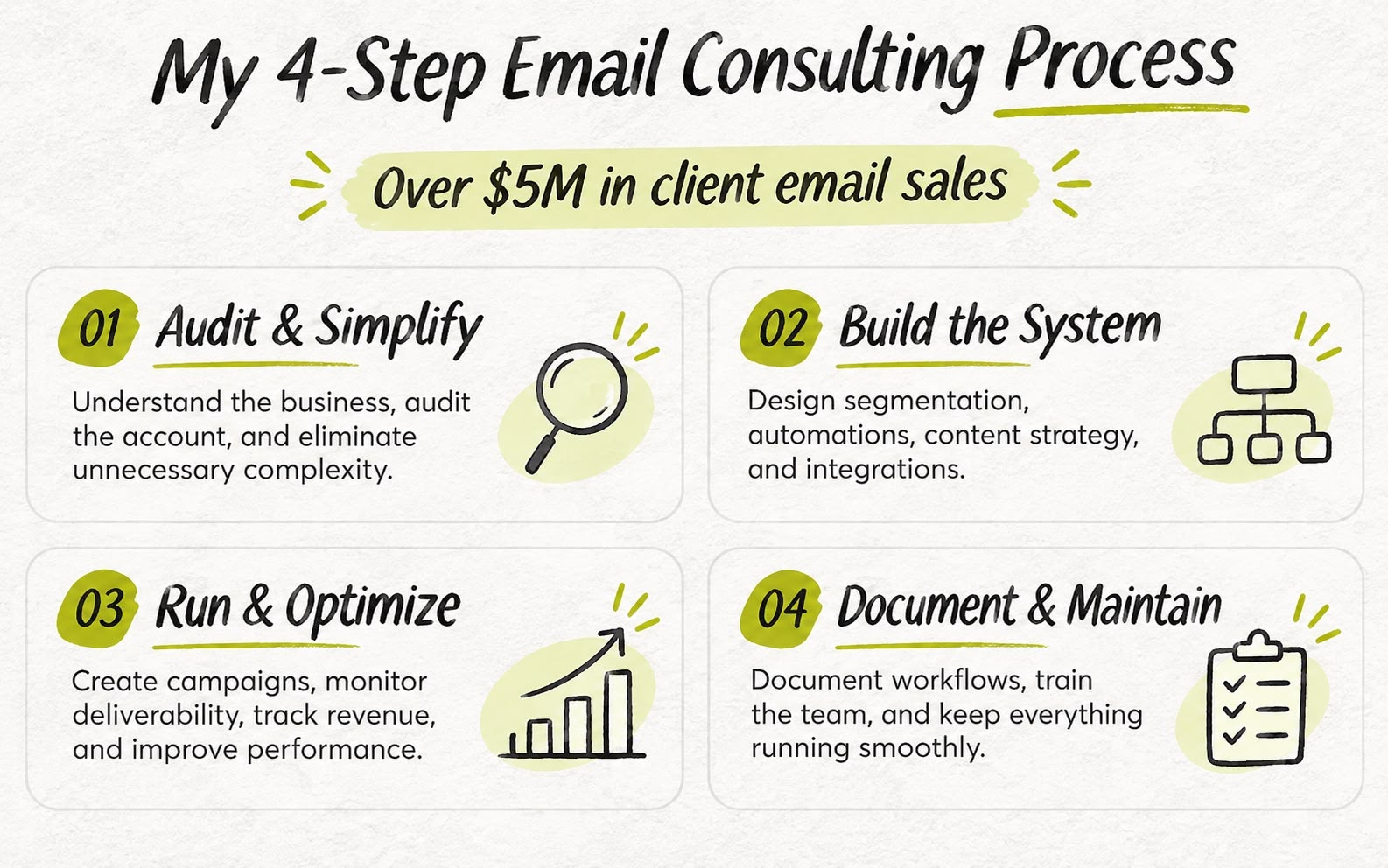
My 4-step email consultant process, that generated over $5M in email sales
Step 1: Dissect the business and email account before making a single change
My ultimate goal is to set up the account so it reflects the business’s priorities. To reach that point, I study its current state without making any decisions yet.
I audit the account first. What’s actually running, what died two years ago, what’s duplicated, what nobody remembers building. Some marketers and agencies do this for free as a foot-in-the-door move. For a big account, I could spend days exploring it, so I rarely offer it for free. There is no visible progress at this point, but it lays the groundwork for later.
Then I need to understand the business, not just the inbox. What they sell, to whom, at what price, how long people take to decide, how people actually arrive, what the product ladder looks like, what the sales process is. It might be surprising to some people, but a profitable email strategy is heavily customized to the way a business operates.
Then I untangle the mess. First task: the tags. I look for patterns and set up a naming convention. Then I simplify the layers within layers of segments (segmenception?) and delete automations that fire when they shouldn’t. Most importantly, I manage (a more pleasant word for delete) the contacts that haven’t opened anything in a year. The name of the game here is deleting. I know that the account with 135 automations and 700 tags is the extreme version, but I’ve never opened an account and found it too simple. Less is more.
Step 2: Set up the right tools and design automations
Once the account is clean, the actual construction starts.
- Segmentation. Deciding who gets what, based on behavior and buying intent, not on whoever’s easiest to filter for. Good segmentation is easy to report on and follows the buyer’s intent. How would I determine intent if I hadn’t dissected the business earlier?
- Flows. Welcome, onboarding, abandoned cart, post-purchase, win-back, launch sequences. Building the flows for each funnel leak, especially on a big account carrying years of old automations, is a lot of work, and again, not always very visible.
- Content strategy and calendar. What gets sent, to whom, when, and why, all of it tied back to the segmentation above. Thankfully, this is very visible, but it’s the end product of the effort that preceded it.
- Integrations. Your email list is the core of your business, so every system collecting data on a contact (forms, webinar tool, payments, CRM, cart) needs to talk to it. A list that doesn’t sync is always a little bit wrong.
Step 3: Run the account day to day
A lot of the invisible actions still happen at this stage, but now an email marketing consultant’s familiar activities take place.
Writing and designing the emails is the part clients picture when they hire someone, and it does take real creative and conversion skill. One person can do it. Agencies usually split it across a few people.
List hygiene and deliverability run underneath everything else. Dead contacts cost money. Bots and spam traps actively damage your sending reputation. The job here is noticing early and exercising our God-given right to delete before they pile up and inflate costs.
Reporting starts with open and click rates, which are fine as a first read, but the real numbers I want my clients to focus on are revenue attributed to email, automations versus campaigns, and value per subscriber. A monthly report with the right KPIs doesn’t say much in month one, but it’s great as a baseline. As the account grows, the reports start telling you a story of our progress beyond “we sent 58 emails.”
Keeping a changelog matters more than most people think. On a big account, an up-to-date changelog makes troubleshooting a matter of a few minutes instead of hours or days. With one client, we noticed a spike in spam reports starting on a specific date. Because we’d kept a changelog, we could see that around that same date, we’d made a significant change to one automation. Connected the dots, found the culprit, saved us from a wasted afternoon.
A/B testing is worth it once the list is big enough for the numbers to have statistical significance. On a small list, it’s a guessing game, and charging a client to run tests to fake sophistication is a waste of money.
Step 4: Document everything and stick to hygiene habits
This is part of the day-to-day operations, but I see so many people giving up on these practices and introducing complexity into their accounts that it deserves its own separate mention.
Documentation. A written and visual map of every automation, what triggers it, what it depends on. I mostly keep this in Google Sheets for the written side and Lucid for the visual map. Nobody, including me, can hold a large account in their head. Every time we introduce a new automation, I add it there.
Training the client. Most consultants avoid this, because a client who doesn’t understand the system is a client who doesn’t leave. I don’t do that. I see it as a disservice. When a client actually understands what’s running, they sometimes catch things I don’t, because they know their business better than I ever will. That’s not always comfortable for the consultant, but it’s the right way to work.
Staying on top of it. Something always breaks, usually the day before a launch. The job is catching it before the client does, and that only works if the documentation is good enough to tell you where to look.
A clean and neat account is not an accident.
Consultant vs. agency vs. in-house
Everything above can be done by one person. Agencies usually split it across several: one person on strategy, one on design, one on deliverability. In-house means someone on your payroll doing it full-time.
None of the three is better by default. Each one carries a different risk, and those risks should guide your decision more than the difference in fees. Here’s how they compare when the job is email specifically:
| Email consultant | Email marketing agency | In-house email marketer | |
|---|---|---|---|
| Who does the work | The person you talked to on the call | Often not the person who pitched you | Your employee |
| Cost | Project fee or monthly retainer | Monthly retainer, usually higher, grows with scope | Full salary, plus benefits, tools and management time |
| Speed to start | Days | Weeks (onboarding, account team) | Months (hiring, then ramp-up) |
| Depth | Deep on email and the platform | Broad across channels, depth varies by who’s assigned | Depends on who you hire |
| Capacity spikes | One calendar. A big launch competes with other clients | Can add people for a launch or a migration | Fixed. A launch could mean overtime |
| Continuity risk | High, unless everything is documented | Low, there’s a team behind the account | Medium. When they leave, the knowledge leaves with them, unless documented |
| Blind spot | Depends on expertise | Anything outside the contracted scope | No outside view. They only know your account |
| Best fit | One clear problem: a messy account, a migration, a system that needs building and running | Email has to run in lockstep with paid, social and the site | Email volume is big enough to fill a full-time job, every month |
The continuity row I take personally. A consultant is a single point of failure by definition. That’s exactly why documentation and client training are part of my process. If I disappeared tomorrow, the map of every automation and the person who understands it would still be in your company.
When each one fits:
- A consultant when the problem is specific but doesn’t justify an in-house hire. Fix the account, build the system, run it properly.
- An agency when email is one of several channels that have to move together, and you need someone coordinating all of them.
- In-house when the workload justifies a full salary month after month. Below that line, you’re paying a full-time wage for a part-time job.
- A mix of the two when you already have a capable generalist in-house who needs senior direction more than extra hands. The consultant sets up the system and the habits, your person runs it day to day.
Red flags when hiring an email marketing consultant
A few, straight from how I work and what I’ve seen elsewhere:
- The onboarding is nearly nonexistent. They don’t ask questions about your business, your product or your goals.
- They start writing emails before they’ve audited the account, building on top of whatever mess is already there.
- They’re cagey about documentation or training you on your own system. If keeping you dependent looks like the plan, it probably is.
- There’s no changelog, no record of what changed and when. It’s unclear whether something broke on its own or the consultant made a mistake. Zero mistakes is usually a sign of trying to hide them. At the end of the day, we’re all human, right? RIGHT?
- They push A/B testing on a list too small for it to mean anything.
- The platform account, the sending domain or the billing isn’t in your name. If you part ways, you should walk away with your list, your automations and your history. All of it.
- Their reports only show activity. “We sent 58 emails” tells you what they did, not what it earned you, and never what they didn’t get to.
- Agreements live in calls and chats instead of in writing.
- There’s no handover plan. Ask on day one what happens on the last day. A good consultant has an answer.
Let’s talk money: cost and when to pay it
Price is the last thing I’d compare, but it’s important to have good reference points. A cheaper option, say a $200/month freelancer, could leave your account without an owner, lock your knowledge inside one person’s head, or tank your sender reputation, costing you significantly more than the fee difference.
Pricing depends on the size of the mess, the size of the list, and whether you’re paying for an audit, a build, or ongoing management. I don’t charge the same for a five-minute cleanup as for untangling 700 tags, and I don’t think anyone should.
What you’re paying for in each case is different:
- In-house: $60k–$140k/year. A salary, plus benefits, tools, and the time someone senior spends managing them. Fixed, whether the month is busy or quiet.
- Agency: $2.5k–$10k/month. A monthly retainer for a team. You pay for capacity and coordination, and the price climbs with scope.
- Consultant: $800–$3k/month. A project fee for one-off work, a retainer for ongoing work. You pay for one person’s expertise and time.
The rule I’d give any business: match the payment to the shape of the work. An audit, a migration or a cleanup has an end, so price it as a project. Putting one-off work on a monthly retainer means paying for capacity you don’t use. Running the account is the opposite: email compounds month after month, so that belongs on a retainer.
Review your current state before you hire an email marketer
If your list is still small and your automations are still simple enough that you could explain all of them from memory, you might not need a consultant yet. The moment you can’t, or the moment nobody at the company can, that’s usually the signal that lets you know you need an expert.
Before you talk to anyone (consultant, agency or recruiter), consider these questions:
- Can someone in the company explain every active automation? If not, start with an audit, not a hire.
- Is anyone currently following the account every week? If nobody is, you need outside help, whichever kind.
- Is the work one-off or continuous? A cleanup or a migration is a project. Running the account is ongoing.
- Is email running alone, or alongside ads, social and the site? The more channels that need to move together, the more you need coordination, not just execution.
- Do you own your platform account, your sending domain and your data? Fix that before anyone new touches it.
If your email is not doing what it should, or you’ve never actually set it up properly to begin with, that’s exactly what I help with. A 20-min call is our starting point to see what’s actually running and what needs to change.
FAQ
How much does an email marketing consultant cost?
Most consultants charge somewhere between $800 and $3,000 per month for ongoing management. One-off work (an audit, a cleanup, a migration) is usually priced as a project, based on how big the account and the mess are. An agency typically starts around $2.5k per month, and an in-house hire costs a full salary plus tools and management time.
What’s the difference between an email marketing consultant and an agency?
With a consultant, the person you talk to on the call is the person doing the work, and the depth is in email and the platform. An agency spreads the work across a team and covers more channels, so it fits better when email has to move in lockstep with ads, social and the site.
How long before I see results from an email marketing consultant?
Don’t expect a spike in sales in the first two months. The first weeks go into the audit and the cleanup, which you won’t see in your revenue yet. The first monthly report is mostly a baseline. The numbers start telling a story once the flows run and the list is clean.
Do I need an email marketing consultant, or can I do it myself?
If your list is small and you can explain every active automation from memory, you can probably run it yourself for now. Once nobody in the company can explain what’s running, or nobody follows the account every week, it’s time for outside help.
What should I ask an email marketing consultant before hiring them?
Ask how they audit an account before they touch it, whether they document the automations, whether they train your team, and what happens on the last day of the engagement. Also make sure the platform account, the sending domain and the data stay in your name.